Introduction
Accrington in the 18th century was a quiet backwater with poor transport links. But that was about to change. Soon the canal arrived, and then the railways. The population ballooned from less than 2000 in 1750 to more than 10,000 in 1850. Moreover, by 1950 there were more than 40,000 residents in Accrington.
The provision of good transport links changed a backwater village into an industrial powerhouse. More people worked in factories than on the land, and the economy boomed. The first turnpike road to serve Accrington was the Manchester to Whalley Turnpike, opened in 1789. The Leeds and Liverpool Canal was built in stages and reached Enfield, in Clayton-le-Moors, by 1820.
The Pre-Industrial Era & Turnpike Roads
Prior to good roads, transport relied on packhorses and horse-drawn waggons. Additionally, winter roads became impassable due to mud or freezing. Moreover, transport was slow and made bulk goods such as coal expensive. By the late eighteenth century the poor roads were creating a bottleneck for expansion, and something had to be done.
Consequently, the first turnpike road to serve Accrington was opened in 1789. Interestingly, the Manchester to Whalley Road was the last to be built by the pioneering civil engineer John Metcalfe. Having a paved road cut travel times and allowed fast stagecoaches to operate for the first time. The coaches had names such as Rocket and Highflyer.
Canals & the Industrial Transition
The Industrial Revolution saw massive expansion of canal building. Boats were used to ship heavy goods around the coast and up navigable rivers. However, inland, bulk goods were difficult to move. As a result, canals were built where one strong horse could pull up to thirty tonnes. The advent of cheap coal led to a boom in mill building, and calico print works such as Broad Oak were operating by the end of the 18th century.
The first power loom weaving mill in Accrington was built close to the turnpike road, on Grange Lane, by William Sykes, in 1815. Notably, Sykes Mill was attacked by Power Loom rioters in 1826, and over 60 looms were smashed.
The Steam Revolution & The Railway Era
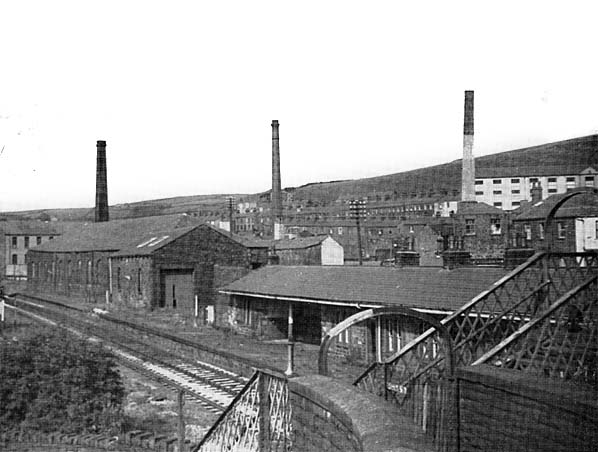
The railway arrived in Accrington only eighteen years after the opening of the Liverpool and Manchester Railway. 1848 marked a great year for the town with a new fast route to Manchester and beyond.
Remarkably, the 22-mile route took only one hour and fifteen minutes to traverse. The line was built by the original East Lancashire Railway and had a steep climb up to Baxenden Bank. The locomotives of the time were relatively small and could travel at up to 35 MPH.
Soon large factory complexes sprang up along the line, the biggest being Howard and Bullough’s. The company was founded in 1856 and became a globally renowned manufacturer of textile machinery on its 53-acre site.
Hence, Accrington grew from a small village to a globally recognised town in only one hundred years, from 1750 to 1850.
I will write a compelling 500-word history essay in two days.
Discover more from The Lancashire History Blog
Subscribe to get the latest posts sent to your email.