Welcome to the Lancashire History Blog.
Latest posts
- Lancashire and the Roman frontier: Betrayal and revenge lead to invasion.
 The Romans invaded Britain for the second time in 43 AD, under the emperor Claudius. Lancashire formed part of Brigantia, an early client kingdom of Rome. However, due to a betrayal, Brigantia became anti-Roman, and invasion followed. The Brigantes rule the North. In the Iron Age the Brigantes ruled the north of Britain as a… Read more: Lancashire and the Roman frontier: Betrayal and revenge lead to invasion.
- September 1848: When the First Train Pulled into Burnley
 Burnley grew rapidly between 1848, when the railway arrived, and the 1890s. In this article OS maps are used to show the rapid growth of railway infrastructure. Burnley’s first railway station was Burnley Westgate (which opened on 18th September 1848 and later became Burnley Barracks). Notably, the station was a temporary terminus that was used… Read more: September 1848: When the First Train Pulled into Burnley
- Preston’s Tramways: From Horse‑Drawn Beginnings to Electric Modernity
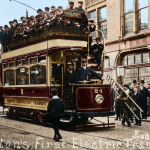 Preston’s tramways developed from modest horse‑drawn routes into a fully electrified urban network before finally giving way to buses in the mid‑1930s. History of Preston Trams Public transport in Preston began with horse buses in 1859, but the town’s tramway era formally started on 20 March 1879, when the Preston Tramways Company opened a 2½‑mile… Read more: Preston’s Tramways: From Horse‑Drawn Beginnings to Electric Modernity
- Haslingden’s lost Station: The Rise, Decline, and Disappearance of a Pennine Railway Stop
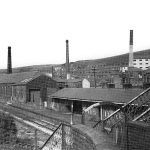 Haslingden station opened in 1848 on the East Lancashire Railway’s Accrington–Stubbins line and closed to passengers in 1960. The entire route closed in 1966. The station stood at the north end of the short Haslingden (North Hag) Tunnel. In addition, it served a rapidly industrialising cotton‑mill town and formed part of the steeply graded climb… Read more: Haslingden’s lost Station: The Rise, Decline, and Disappearance of a Pennine Railway Stop
- Turton Tower: From Medieval Stronghold to Victorian Retreat
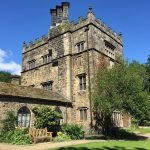 Turton Tower is one of Lancashire’s most distinctive historic houses — a rare survival of a medieval pele tower that evolved over five centuries into a Tudor manor, a Victorian gentleman’s residence, and finally a public museum. Its story reflects shifting patterns of defence, domestic comfort, local power, and heritage preservation. Origins and Early Lords… Read more: Turton Tower: From Medieval Stronghold to Victorian Retreat