Preston’s tramways developed from modest horse‑drawn routes into a fully electrified urban network before finally giving way to buses in the mid‑1930s.
History of Preston Trams
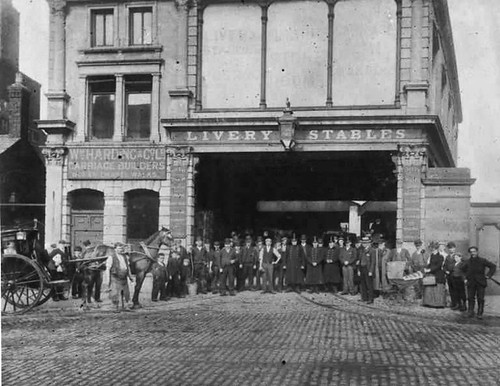
Public transport in Preston began with horse buses in 1859, but the town’s tramway era formally started on 20 March 1879, when the Preston Tramways Company opened a 2½‑mile horse‑drawn tramway under the provisions of the 1870 Tramways Act. These early trams were popular but labour‑intensive: horses required feeding, watering, and stabling and produced considerable street waste. Contemporary accounts describe the system as effective but demanding, with stabling largely provided by W. Harding & Co. Ltd., whose premises dominated Fishergate Hill until redevelopment in 1902. You can see the tram lines in the image below.
A major turning point came on 31 December 1886, when Preston Corporation bought out the horse‑tram operation. The corporation expanded the system during Guild Week 1882, adding routes from Fishergate Hill to New Hall Lane and from the Town Hall to Ashton, laying the foundations for a more comprehensive network.
Preston’s trams go electric
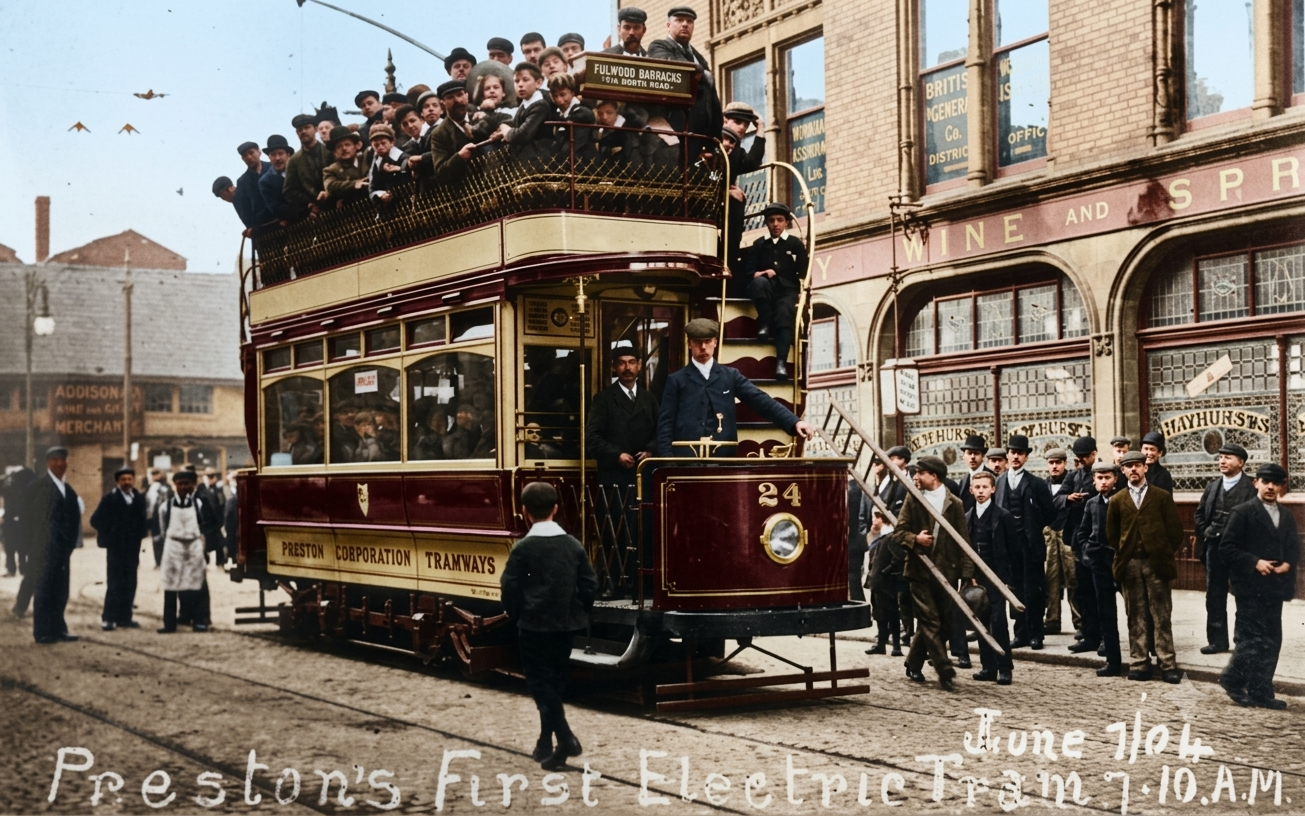
By the turn of the century, electrification had become essential. Acts of Parliament in 1900 and 1902 empowered Preston Council to modernise the tramways, leading to the construction of a dedicated power station and a new depot at Deepdale. On 7 June 1904, the first electric tram ran on Lancaster Road, marking the end of the horse‑drawn era. The electrification work—covering cars, track, overhead wiring, and generating plant—was carried out by Dick, Kerr & Co. of Preston, one of Britain’s leading electrical engineering firms.
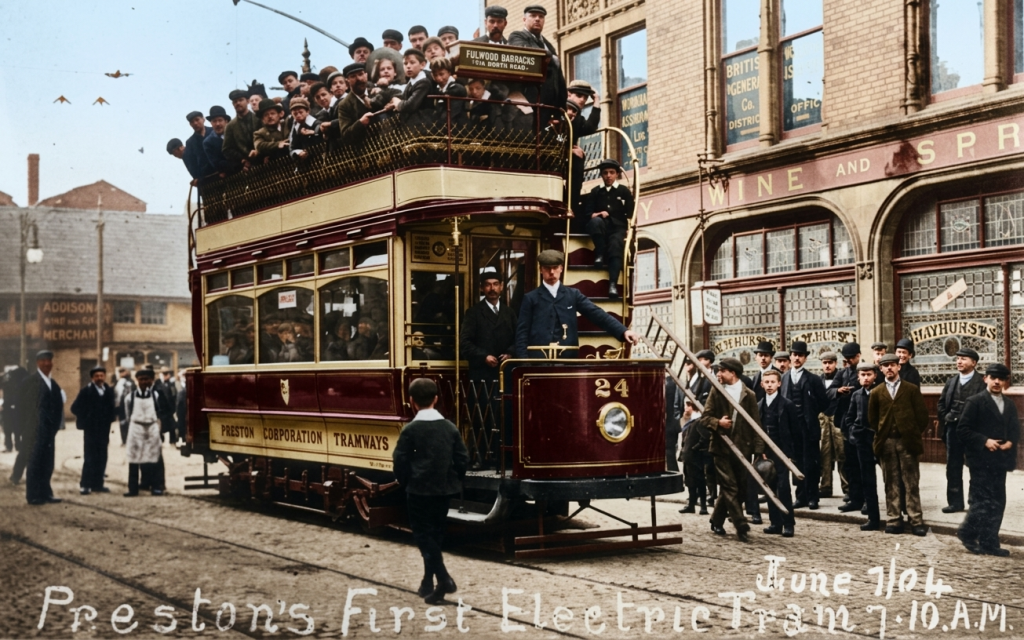
By 1912, the corporation operated 30 double‑deck cars and added four single‑deck vehicles. Routes extended to Penwortham Bridge, Ashton‑on‑Ribble, Ribbleton, Farringdon Park, and Sharoe Green Lane, with a circular service via Fulwood. The system ultimately reached 10.53 miles of track, forming a dense urban network that carried millions of passengers.
Preston’s early buses
Despite its success, the tramway faced mounting challenges in the 1920s. The track and cars required costly renewal, and buses—first introduced in 1922—offered greater flexibility and lower operating costs. By 1930, the council concluded that full conversion to trolleybus and motor‑bus operation was inevitable. Routes were progressively replaced between 4 July 1932 and 15 December 1935, when the final tram departed from Fulwood, ending Preston’s tramway era.
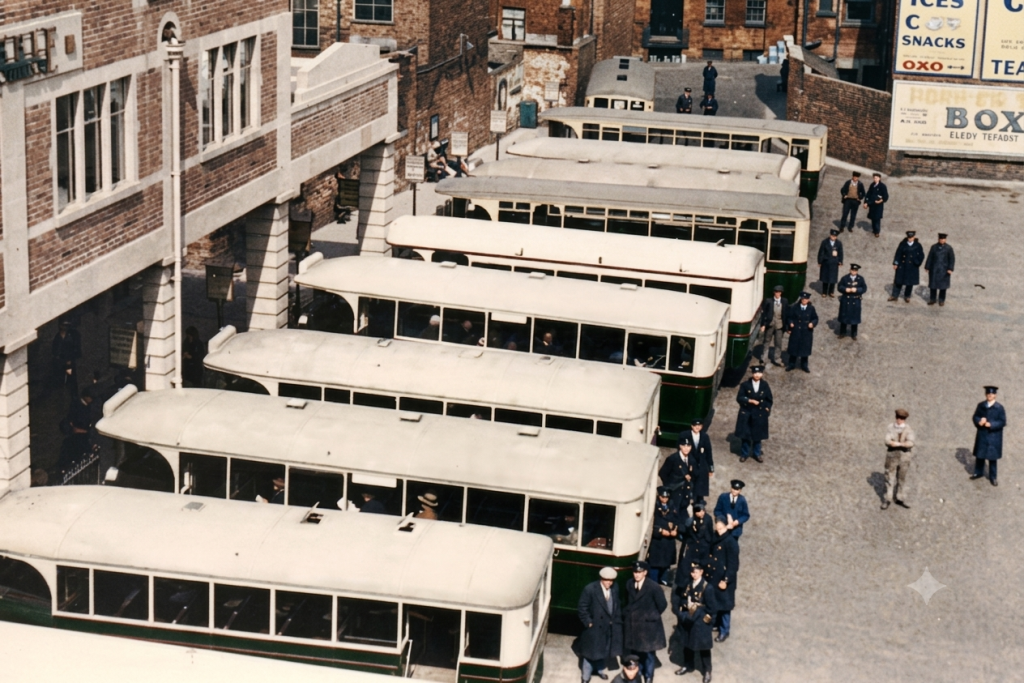
During their lifetime, Preston’s trams ran over 32 million miles and carried more than 370 million passengers, a testament to their importance in shaping the city’s transport history.
Although the tramways closed in 1935, interest in revival periodically resurfaced. A modern proposal—Preston Trampower’s Guild Line—emerged in 2010, aiming to reintroduce trams between the railway station and Redscar Business Park, echoing the legacy of a system that once defined Preston’s streets.
Discover more from The Lancashire History Blog
Subscribe to get the latest posts sent to your email.